On October 21, 2026, backup dancers in look-alike blue-and-white uniforms joined My Chemical Romance at the Hollywood Bowl and picked up prop rifles for a staged firefight. Five days later, the company behind the Dallas Cowboys Cheerleaders asked a Texas court to keep that look off the stage.
The Hollywood Bowl Costumes Prompt a Trademark Challenge
Pro Silver Star, Ltd., which manages the cheerleading brand, sued My Chemical Romance and Live Nation Entertainment, Inc. on October 26, 2026, in the 493rd District Court of Collin County, Texas, according to the official Collin County case record for Case No. 493-08658-2026. The filing is a verified petition with an application for a temporary restraining order and temporary injunction.
Reporting on the court papers says the company alleges that audience members and social media users mistook the dancers for official team cheerleaders, and that the routine damaged the brand’s reputation. TheWrap reported that Pro Silver Star asked the band to stop using the costumes and alleges the band refused. The company wants the costumes barred from future shows and seeks unspecified damages.
Pro Silver Star also owns a federal registration for the uniform itself: U.S. Registration No. 2,906,113, a live, renewed service mark whose drawing contains no words, letters, or numbers.
The docket sets the restraining-order hearing for October 28, 2026, at 9:00 a.m., and the promoter’s concert page lists two more Hollywood Bowl shows on October 30 and October 31. As of October 27, 2026, the docket showed no order granting emergency relief.
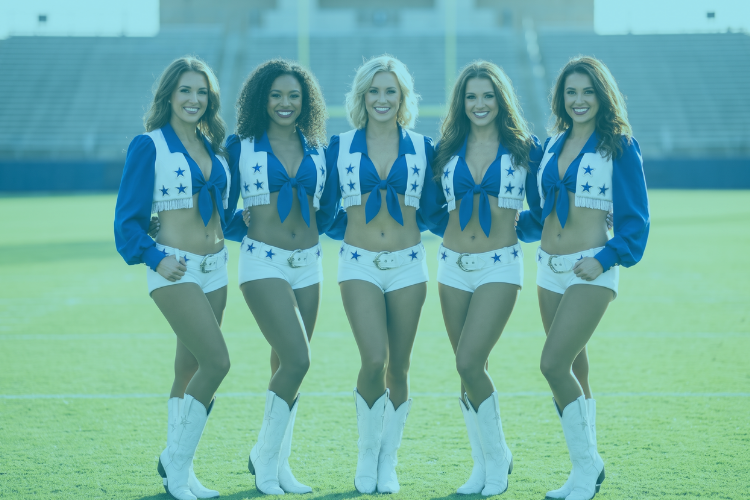
How a Uniform Can Signal Affiliation
Trade dress is the legal term for an appearance that tells the public who stands behind a product or service. The DCC registration describes a specific combination: a tied blue blouse, a fringed white vest with blue stars outlined in silver, white shorts with a V-shaped front, and western boots. The record claims acquired distinctiveness for the whole design, which means the owner had to show that the public came to link the design with a single source through use. When I assess a design mark like this, I start with the full combination, since a fringed vest or western boots alone say little about source.
A federal appeals court has read this uniform as a sponsorship signal before. On August 14, 1979, the Second Circuit affirmed a preliminary injunction in Dallas Cowboys Cheerleaders, Inc. v. Pussycat Cinema, Ltd., a case over the uniform’s use in the film Debbie Does Dallas and its advertising. The court discussed the design’s nonfunctional combination and the risk that viewers would assume the cheerleaders sponsored or approved the film.
Reporting describes the current claims as false endorsement, trademark infringement, and dilution, which puts the same sponsorship question in front of a court again. Federal law frames the affiliation question in 15 U.S.C. § 1125(a), which reaches uses likely to cause confusion about affiliation, connection, sponsorship, or approval. That standard fits the allegation that viewers thought the official squad had joined the performance. I wrote earlier about how visual cues can suggest an authorized collaboration in a retail dispute.
Dilution under Section 1125(c) works differently: it protects famous marks against blurring and tarnishment even without confusion, and the reputation allegation describes the kind of harm tarnishment addresses. A mark qualifies as famous only if the general consuming public of the United States widely recognizes it as a source signal. The statute also excludes certain uses, including parody, commentary, news reporting, and noncommercial use, and several of those carry conditions.
A concert also brings in the expressive-use question from Jack Daniel’s Properties, Inc. v. VIP Products LLC. On June 8, 2023, the Supreme Court held that the Rogers test, a threshold filter for expressive works, does not apply when the accused use designates the source of the user’s own goods. The Court left Rogers’ broader validity open. In a dispute like this one, my first question is what job the borrowed design performs inside the show, because that answer shapes which analysis a court applies.
A Sports Uniform With an Entertainment Business Behind It
On February 26, 2018, the Smithsonian’s National Museum of American History documented a donation of historical and contemporary DCC uniforms to its sports collection and traced the recognizable design to 1972. The museum’s account also covers the squad’s public appearances and merchandising, which carried the look well past the sideline.
That recognition grew out of a business. The registration covers choreographed entertainment at football games, exhibitions and personal appearances, online sports and entertainment information, and fan-club services. The official DCC history describes an entertainment operation that expanded into television, calendars, posters, and dolls.
Live Nation lists five October 2026 Hollywood Bowl dates for My Chemical Romance, whose show uses elaborate theatrical staging. In that setting, a familiar costume can carry meaning with no team name printed anywhere on it, drawing on recognition the DCC uniform has built since 1972.
Licensing is how owners decide where that recognition appears. A license sets who may use the brand, in what settings, for how long, and under what quality standards, which keeps the owner in control of how the public meets the mark. A licensed performer wears the uniform under terms the owner wrote. For a performance identity, the setting matters as much as the design: the same outfit reads one way at a halftime show and another way in a staged firefight. My guide to how trademark licenses define permitted uses covers scope, quality control, territory, and duration in more detail.
Artists build meaning from shared cultural images, and a concert stage invites that kind of reference. Court papers quoted by FOX 7 say the company “takes no issue with MCR’s music, its artistic ambitions, or any message Defendants seek to convey” and wants only that the performers “not wear the DCC Uniform” while they perform. The commercial tension sits in one garment: an image the company presents through its own channels, worn in a production it did not stage.
Build a Review Process for the Whole Production
For creative teams, a useful review starts before costumes are made or show dates are promoted. Gather the full creative set: costume sketches, reference photographs, stage directions, spoken introductions, promotional images, and recorded clips. A sketch shows the design. Stage directions and spoken introductions show what the performers do and say around it. A promotional image shows how the design will be framed and sold, and a clip shows how it plays in motion.
With that set in hand, compare the intended reference against what the audience will actually see and hear. A team may intend a costume as commentary while the dialogue, staging, and promotion together suggest an official appearance. When I review a creative concept, I look at branding and expressive use together, because the answer to one often shapes the other.
Next, search the visual configuration itself. A word-only search misses the central asset in a matter like this, since the DCC registration contains no words at all. Review the particular design and related services against registration records and actual marketplace use, comparing the costume’s full combination of elements with the owner’s registration drawing and description. Then have counsel read the results for how close the designs are and whether the services overlap.
If the team pursues permission, put the scope in writing: live appearances, photographs, video, promotion, territory, duration, approval rights, and quality controls. Approval rights matter most for live work, where a routine can change between rehearsal and opening night. A retail purchase gets you the garment, while presenting a brand inside a ticketed production raises a separate permission question.
Owners of recognizable visual brands have a parallel records task. Keep dated evidence of use, current registration records, license and permission files, relevant social posts, and correspondence. Dated records let counsel show when and where the design has appeared. That file becomes the base for building an enforcement plan around usable evidence.
On either side, name one person to preserve evidence, coordinate counsel, and weigh options if an objection arrives. Those options include a closer review, permission talks, a redesign, or a tailored legal response, and the choice turns on how close the use is, what permission exists, and how soon the next appearance is.
Put the Visual Brand on the Review Calendar
If a show, campaign, or launch built around a recognizable look is on your calendar, review it before costumes, sets, and promotions are locked. Late changes ripple through every piece built around the design, from fittings and set pieces to promotional photos already in circulation.
I search federal, state, common-law, and internet sources for conflicting names, and I personally prepare and file trademark applications for business names, brands, and logos. For registered marks, I run regular USPTO searches for confusingly similar marks. Throughout the process, you deal directly with me.
Before your next planned use, contact my office to discuss your visual brand and the production or product it will appear in.