For a U.S. registration under Sections 1 or 44, file a Section 8 declaration between the fifth and sixth anniversaries, then file combined Sections 8 and 9 between the ninth and tenth anniversaries and every ten years afterward. I start with the registration date on the certificate because that date determines which filing window applies.
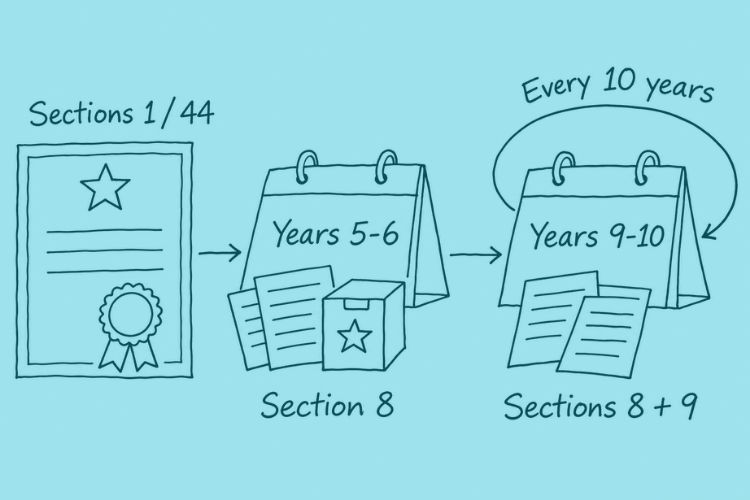
When to File Your Trademark Maintenance and Renewal Documents
The USPTO’s post-registration timeline counts every deadline from the date on your certificate. For a U.S. registration under Sections 1 or 44, the required filings look like this:
| Filing Window | Document | Function |
|---|---|---|
| Fifth to sixth anniversary | Section 8 | Declares continued use or excusable nonuse |
| Ninth to tenth anniversary | Combined Sections 8 and 9 | Declares continued use or excusable nonuse and requests renewal |
| Nineteenth to twentieth, twenty-ninth to thirtieth, and onward | Combined Sections 8 and 9 | Repeats the same filing every ten years |
Section 8 is the use declaration, and Section 9 is the renewal request that first comes due at year ten. Section 15, a declaration of incontestability, is optional, has its own eligibility rules, and replaces neither required filing.
If your application serial number starts with 79, your U.S. registration came through the Madrid Protocol under Section 66(a), and this table changes. You file a Section 71 declaration on the same U.S. anniversaries in place of Section 8, and you skip Section 9 because renewal goes directly to WIPO every ten years, counted from the international registration date.
Take a hypothetical registration dated August 30, 2023, under the ordinary schedule. Each anniversary marks the end of an elapsed year, so the fifth anniversary falls on August 30, 2028.
| Filing | Window Opens | Ordinary Deadline | Grace Ends |
|---|---|---|---|
| First Section 8 | August 30, 2028 | August 30, 2029 | February 28, 2030 |
| First combined Sections 8 and 9 | August 30, 2032 | August 30, 2033 | February 28, 2034 |
The last column reflects a six-month grace period that follows each deadline at added cost. February has no 30th, so the period ends on February 28. If a deadline lands on a Saturday, Sunday, or federal holiday, the USPTO treats a filing received on the next business day as timely. None of these example dates needs that adjustment.
A filing made before its window opens is too early, so put the opening date on your calendar. Filing early in the window leaves time to fix correctable errors at no extra charge.
Miss the end of the grace period with no filing at all, and the registration is canceled or expires. The USPTO has no authority to extend the Section 9 deadline, and a registration canceled for that failure cannot be revived, so the owner must file a new application. A timely filing with a problem gets a different result: the USPTO sends an office action explaining the refusal and any remedies. Common law rights raise a separate question, because the mark in a dead registration may still be in use in commerce, and any such rights reach only the area where it is used.
Prepare the Evidence and File the Correct Form
A maintenance filing connects the existing registration to the current owner and to what that owner sells under the mark, so work in this order:
- Retrieve the registration from the USPTO’s Trademark Status and Document Retrieval (TSDR) system and confirm the number, owner, and address.
- Review the listed goods and services, class by class, and mark anything no longer sold.
- Collect a specimen for each class you are keeping.
- Choose Section 8 or combined Sections 8 and 9 from the schedule above.
- Complete and sign the declaration.
- Submit the filing and save the receipt.
- Check TSDR for the outcome.
The declaration you sign covers every item you leave on the registration, which is why step 2 comes before any evidence gathering. The USPTO normally asks for one specimen per class and can ask for more. That single example represents the class in the filing, and the use claim still has to be accurate for every other item kept in that class.
A good specimen shows the mark in actual use in commerce. For goods, that can mean a photograph of actual packaging or a label bearing the mark, such as the USPTO’s example of a laundry detergent box. For services, advertising or a website can qualify when it directly connects the mark with services you actually provide. Webpage evidence needs its URL and the date you accessed or printed it. A digital mockup fails this test because it depicts an intended use, and a bare logo fails because nothing links it to a service.
Items you have stopped selling need a decision before you sign. You can delete them, or you can claim excusable nonuse if special circumstances beyond your control caused the interruption and you have no intent to abandon the mark. That claim requires facts: the date use stopped, the reason, the steps you are taking to resume, and the approximate date you expect to resume. Decreased demand does not qualify, and neither does a business decision to stop.
With the evidence settled, go to the USPTO maintenance forms page, which links the Section 8 and combined Sections 8 and 9 forms to Trademark Center. You need a USPTO.gov account with two-step authentication and a verified identity, so set those up before your deadline approaches.
A receipt confirms that the filing went in, and acceptance comes later, after a post registration trademark examiner reviews the filing and the USPTO issues a notice or an office action, usually in about one to two months. Check TSDR soon after filing and again a couple of months later, and answer any office action, because ignoring one on a Section 8 or Section 9 filing leads to cancellation or expiration.
Budget for Government Fees, Classes, and Corrections
Three things set your government charge: the filing type, the number of classes you keep, and whether you file in the grace period. The USPTO fee schedule lists these electronic filing fees per class:
| Filing | Fee Per Class | Grace Addition Per Class | Total Per Class in Grace | Status |
|---|---|---|---|---|
| Section 8 | $325 | $100 | $425 | Required |
| Combined Sections 8 and 9 | $650 | $200 | $850 | Required |
| Combined Sections 8 and 15 | $575 | $100 | $675 | Section 15 is optional |
If you are budgeting for a new application instead of maintenance, my guide to the cost to trademark a name at the application stage covers that separate spending.
The fee schedule’s $325 line for Section 9 is easy to misread as the whole ten-year bill. The ten-year filing also includes the $325 Section 8 charge, which brings the total to $650 per class. Grace works the same way, with $100 added for each part.
Classes multiply every figure in the table, so a two-class registration pays $650 in government fees for an ordinary Section 8 filing and $1,300 for an ordinary combined Sections 8 and 9 filing. File that combined document in the grace period, and the two classes cost $1,700.
Deleting goods or services before or with your declaration carries no deletion fee. Deleting them after you file and before the USPTO accepts the declaration costs $250 per affected class, and leaving that fee unpaid past the office action deadline cancels the entire registration.
Section 15 is a separate choice at $250 per class when filed alone. An attorney’s fee sits outside all of these figures and is quoted separately.
Decide Whether to File Yourself or Use an Attorney
If you are domiciled in the United States, you are not required to hire an attorney for a maintenance filing. Foreign-domiciled registrants must be represented by a U.S.-licensed attorney, which settles the question for them.
For U.S. owners, the choice depends on how clean the record is. Self-filing is worth considering when the owner on the certificate is still the owner, the goods and services match what you sell, your evidence plainly shows the mark in use, and you are comfortable signing the declaration.
These situations are good reasons to get legal review first:
- The mark has been assigned, or the business has merged or changed entities, so the correct owner is no longer obvious.
- You are unsure whether a specimen shows actual use.
- Use stopped for some or all of the goods or services, and you need to weigh deletion against excusable nonuse.
- You cannot tell which items should stay on the registration.
- The USPTO has issued an office action with a response deadline.
When I evaluate a filing, I read the registration record beside the evidence and ask whether each listed item has a clear yes or no answer. You can run that same comparison yourself. If every line resolves cleanly, filing on your own is a reasonable choice. If several lines stay open, an attorney’s review gives you a legal opinion on those items before you sign, along with someone to represent you if the USPTO responds with an office action.
Next Steps
Gather your registration number, your certificate, and current evidence for each good or service you plan to keep. Check the registration date against the schedule to see which filing comes next, and note any evidence you still need.
I can review the record with you, identify the required filing, and prepare the documents it needs. I work personally with every client, so you will deal with me directly at each step.
To have your registration reviewed, contact my office with the registration number and your question about the next required filing, and I will assess what it needs.